Explore the fascinating history of Round Rock, Texas and discover why it remains one of the most sought-after and reliable real estate markets in the Austin area. Expert insights from Tanya Kerr Real Estate.
There is a reason Round Rock keeps showing up at the top of best places to live lists year after year. It is not an accident and it is not just marketing. Round Rock has earned its reputation as one of the most livable, most stable, and most consistently desirable communities in the entire Austin metro through decades of smart growth, strong community investment, and a track record that speaks for itself.
At T. Kerr Property Group we work across the Austin area every day and Round Rock is a market we know deeply and respect enormously. Understanding why requires going back to where it all started.
How Round Rock Got Its Name
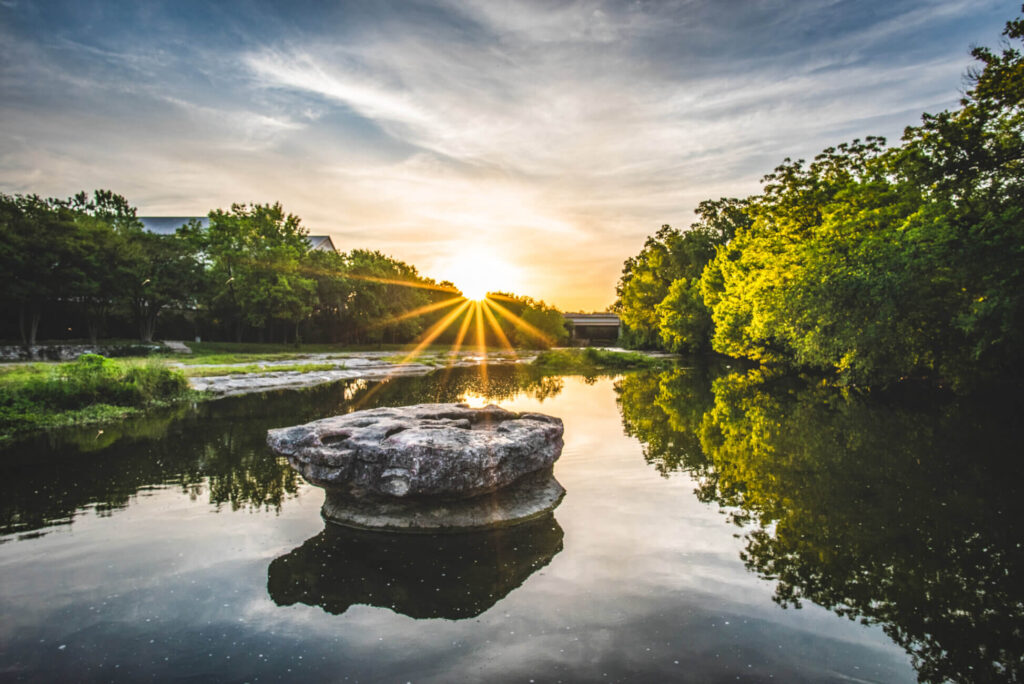
The story of Round Rock begins, quite literally, with a rock. A large, rounded limestone rock sitting in the middle of Brushy Creek served as a natural crossing point for travelers, traders, and cattle drivers moving through central Texas in the mid-1800s. That rock became a landmark, a reliable reference point on the frontier, and eventually gave the settlement that grew up around it its name.
It is one of those origin stories that feels almost too good to be true, but it is entirely real. That same rock still sits in the creek today, a quiet piece of history in the middle of a city that has grown to over 130,000 people.
Early Settlement and the Cattle Trail Era
Round Rock was formally established in 1851 when settler Thomas Oatts built a grist mill on Brushy Creek, creating an anchor for the small community beginning to form in the area. The settlement grew steadily through the 1850s and 1860s, shaped by its position along one of the most heavily traveled routes in central Texas.
The Chisholm Trail, one of the most famous cattle driving routes in American history, passed through the Round Rock area during the great cattle drives of the post-Civil War era. Millions of longhorn cattle were driven north through this corridor from the Texas ranches to the Kansas railheads, and Round Rock was a key stop along the way. That heritage is still celebrated in the community today and connects Round Rock to one of the most iconic chapters in Texas history.
The Railroad and Sam Bass
Two things defined Round Rock’s identity in the late 1800s more than anything else: the arrival of the railroad and the death of an outlaw.
The International-Great Northern Railroad came through in 1876, bypassing the original Round Rock settlement slightly to the north and establishing New Round Rock, which eventually became the dominant town center. The railroad brought commerce, connectivity, and growth that transformed Round Rock from a frontier waypoint into a genuine community.
That same year, Round Rock became the site of one of the most famous episodes in Texas outlaw history. Sam Bass, a notorious train robber who had become something of a folk legend across the state, was shot and killed by Texas Rangers in Round Rock in July 1878 after a tip from one of his own gang members. Bass died two days later on his 27th birthday and is buried in the Old Round Rock Cemetery, where his grave remains a local landmark visited by history enthusiasts to this day.
It is the kind of story that could only happen in Texas.
Growing Into the 20th Century
Round Rock spent much of the early and mid 20th century as a quiet agricultural community, known for its cotton farming and its role as a local trading center for Williamson County. The population remained modest and the pace of life reflected the rhythms of small town Texas.
That began to shift meaningfully in the 1960s and 1970s as Austin’s growth started extending northward and Round Rock’s position along IH-35 made it an increasingly logical location for both residential and commercial development. The groundwork was being laid for what would become one of the most significant growth stories in Texas.
Dell Changes Everything
If there is a single moment that defines modern Round Rock it is the decision by Dell Technologies to establish its world headquarters in the city in 1984. What Michael Dell started in a University of Texas dorm room became one of the most successful technology companies in history, and Round Rock became its home.
The arrival and growth of Dell brought thousands of high-paying jobs to the area, attracted a highly educated workforce, and signaled to other employers and developers that Round Rock was a serious place to do serious business. The ripple effects of that decision have shaped everything about Round Rock’s modern identity, from its housing market to its retail base to its demographic profile.
Dell remains one of the largest employers in the Austin metro today and continues to anchor Round Rock’s position as a genuine employment destination rather than simply a bedroom community.
Sports, Community, and the Round Rock Express
Round Rock’s community identity took on another dimension in 2000 with the arrival of the Round Rock Express, the minor league baseball affiliate that quickly became one of the most beloved sports franchises in Texas. Dell Diamond, the Express’s home stadium, became a gathering place for the community and a source of civic pride that transcended baseball.
The Express has produced a remarkable roster of future major league stars over the years and the tradition of summer evenings at Dell Diamond has become woven into the fabric of Round Rock family life in a way that speaks to the community’s investment in quality of life beyond just jobs and housing.
The Education Story
Round Rock Independent School District is one of the most important factors driving real estate demand in the area and deserves direct acknowledgment. RRISD has consistently been recognized as one of the strongest school districts in Texas, offering a combination of academic achievement, extracurricular depth, and community investment that attracts families from across the metro.
For buyers with school-age children, the quality of RRISD is frequently one of the primary reasons Round Rock rises to the top of their list. That consistent draw creates a stable and motivated buyer pool that has supported the Round Rock market through multiple economic cycles.
Round Rock Today: The Reliable Performer
Round Rock today is a city of over 130,000 people with a mature infrastructure, a diverse employment base, strong schools, abundant retail and dining, and a community character that manages to feel both welcoming and well-established. It is the kind of place where families put down roots and stay, which is one of the most meaningful indicators of a healthy real estate market.
At T. Kerr Property Group we often describe Round Rock as the reliable workhorse of the Austin area market. It does not always generate the same breathless headlines as some of the faster-moving suburban stories further north. What it does is perform consistently, hold its value reliably, and attract a steady stream of motivated buyers who have done their research and know exactly what they want.
Why Round Rock Makes Sense for Buyers and Investors Right Now
The data we track across Williamson County tells a compelling story about where the market is and where it is heading. Round Rock sits within a county that saw residential sales increase 4.4% year over year in early 2026, even as national headlines painted a cautious picture of the broader housing market. Williamson County‘s median sale price is $395,000 with an average price per square foot of $195, offering a value proposition that is genuinely difficult to match anywhere in the Austin metro at this price point.
For families, Round Rock offers the combination of RRISD schools, established neighborhood infrastructure, proximity to major employers along the IH-35 and 45 corridors, and a community feel that newer, faster-growing suburbs are still working to develop. These are not abstract qualities. They are the things that drive sustained demand and protect long-term value.
For investors and developers, Round Rock’s maturity is actually an asset. The fundamentals here are proven and durable. The move-up buyer opportunity is particularly interesting right now, as a significant cohort of buyers who purchased entry-level homes in Round Rock five to ten years ago are ready to trade up and want to stay in the community they know and love. Well-positioned product that speaks to that buyer can perform very strongly in the current environment.
What Sets Round Rock Apart in the Austin Suburb Conversation
Every suburb in the Austin area has its story and its appeal. Georgetown has its historic charm and emerging identity. Cedar Park and Leander are pulling younger buyers with their growth energy. Pflugerville offers value and accessibility. Round Rock sits in a category of its own because it has already become what the others are still working toward.
It has the schools. It has the employers. It has the infrastructure. It has the community identity. And it has a track record of market performance that gives buyers and investors a level of confidence that is hard to put a price on.
Our Commitment to Round Rock and the Surrounding Communities
T. Kerr Property Group has deep roots in Round Rock and across the Williamson County communities. We are not just observers of this market. We are active participants in it every day, bringing local knowledge, honest market insight, and genuine expertise to every client conversation.
We believe that understanding a community’s history and identity is part of understanding its real estate market. Round Rock has earned its reputation over more than 170 years of history and we are proud to help our clients become part of that story.
If you are thinking about buying, selling, or investing in Round Rock or the surrounding Austin area communities, we would love to have that conversation.
Ready to explore what Round Rock has to offer? Reach out to the team at T. Kerr Property Group. We are here to help you navigate this market with confidence and clarity.
Contact us at tkerrrealestate.com | T. Kerr Property Group